

01
Material grade recovery
Assess whether target separation could improve the value and consistency of your recovered metals.

Machine vision, robotic handling, and spectral analysis configured around your material stream. Starting with brass.
We turn AI and embodied intelligence into practical sorting decisions for real scrap — beginning with brass. The system is configured around the material, not the other way around.
Scroll to run the sequence. Locate, grasp, identify and place happen as one continuous movement — the same order the system executes on your material.
Machine vision estimates piece geometry, position and grasp targets across an irregular feed.
The system selects a target and executes a controlled pick within the robot envelope.
Visual and, where configured, spectral information confirm the material decision.
The piece is released into its defined output stream for downstream quality review.
Demo context / Concept storyboard · Mixed yellow-metal scrap · Normal-speed footage to replace at launch
Brass is the first application because the material distinction has clear commercial value. The assessment starts with what enters your plant, the grades you need, and the output you can sell.
Yellow-metal scrap with varied geometry, surface condition and overlap.
The brass categories and acceptance rules your operation requires.
Selected pieces placed into defined streams for downstream quality review.
The economic case depends on your material, facility, staffing, integration cost and actual output quality. We help frame the right assessment.
Assess whether target separation could improve the value and consistency of your recovered metals.
Explore where automation can fit staffing, supervision and handling routines.
Evaluate processing capacity and output consistency under your mix, part dimensions and operating conditions.
An integrated system connects perception, robotic handling, material decisions and evidence feedback around one sorting task.
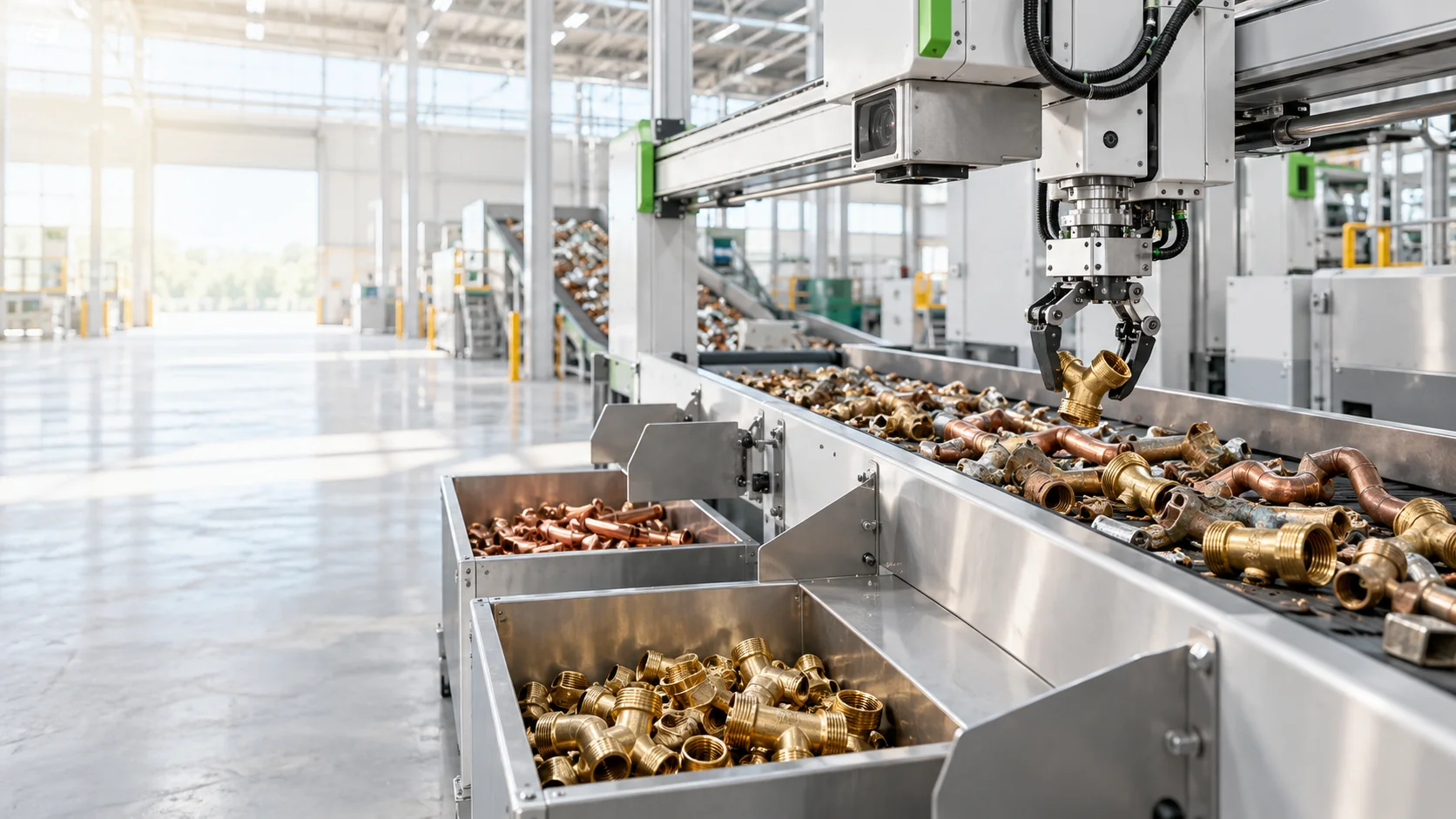 Concept system view
See shape, location and spatial context in variable feeds.
Pick irregular pieces and manage the handling result.
Use spectral information when included in the configuration.
Learn from permitted, clearly documented test data.
A credible result shows the material, test time, operating conditions, outcome and human intervention. Throughput, purity, availability and economic claims are published only after verified testing.
For applicable materials and operating conditions, as an acceptance requirement — not a measured field result. Test results will be published with their conditions once verified.
Rated payload, gripper opening and working radius are published with their measurement basis once confirmed.
A pick completed and released into the intended output without manual recovery.
Correct material decision over the assessed sample; the sampling method is stated.
Share of target material in the output stream, measured by weight over a defined sample.
Scheduled operating time the system is available to sort, excluding planned maintenance.
Operator actions required per operating period, with the trigger recorded.
Space, power, material flow, safety, network, training and service determine whether a system fits your plant. These are reviewed in the application assessment.
Footprint, access, clearance and material flow through the plant.
Supply capacity, connection point and services required at the cell.
Conveyor, bin or manual feed; output containers and changeover.
Guarding, emergency stop, restricted zones and site risk assessment.
Site connectivity, data access, permissions and remote support.
Operator and supervisor training for routine operation and checks.
Preventive maintenance, spare parts and response scope by region.
Bring drawings, constraints and material photos to the assessment.
Final site requirements, certification documents and service scope are confirmed for each installation and included in the quotation package.
The team's perspective comes from long exposure to scrap trading, quality decisions and plant operations — which is why the first application is a specific material task, not a general-purpose robot.
Doctor Scrap industry experience informs this perspective. Customers, awards, projects and data are attributed to the correct legal entity and its actual relationship with Next Move before publication.
Read the company story ↗Sorting decisions are tied to the categories, quality and commercial value that matter at the scale.
Perception, grasp planning, sorting decisions and system integration are developed as one stack.
Brass first; additional materials are added only as configuration and validation support them.
Tell us what you have and what you need separated. We will discuss application fit and the next evaluation step.
Request a Material Assessment ↗